



R.E.News International- Where Do Oil and Gas Really Come From?
 30/09/26-FR-English-NL-footer
D’OÙ VIENNENT VRAIMENT LE PÉTROLE ET LE GAZ ?
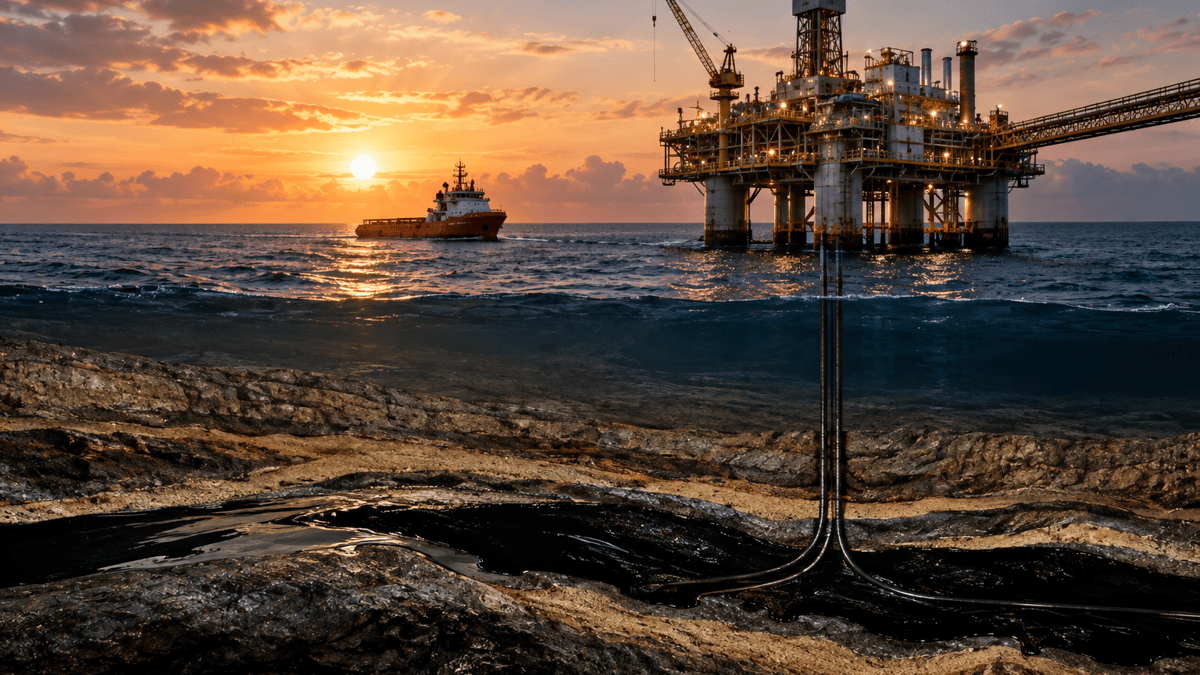 Image-creation R.E.News© via IA chat GPT
Sous nos pieds, une autre usine à hydrocarbures fonctionne depuis des centaines de millions d’années.
Le pétrole raconte une histoire ancienne. Dans chaque baril de brut se cachent des signatures chimiques capables de relier certains hydrocarbures aux micro-organismes, algues et matières organiques déposés dans d’anciens environnements sédimentaires.
Enfouis, chauffés et transformés pendant des millions d’années, ces matériaux deviennent du kérogène, puis génèrent pétrole et gaz. Les hydrocarbures migrent ensuite à travers les roches jusqu’à rencontrer un réservoir et un piège géologique.
Mais l’histoire ne s’arrête pas là.
L’AUTRE FABRIQUE DE LA TERRE
À plusieurs dizaines de kilomètres sous nos pieds, dans un monde de pression, de chaleur et de chimie extrême, la Terre peut également fabriquer des hydrocarbures sans intervention de la vie.
Lorsque l’eau rencontre certaines roches riches en fer et magnésium du manteau, des réactions de serpentinisation peuvent produire de l’hydrogène. Celui-ci peut ensuite participer à la formation de méthane.
Des expériences réalisées dans des conditions proches de celles du manteau terrestre ont même montré la formation de molécules plus complexes : éthane, propane et butane.
La géologie possède donc bien sa propre chimie des hydrocarbures.
LE MYSTÈRE EST DANS L’ÉCHELLE
C’est ici que la science devient fascinante.
Prouver qu’un hydrocarbure peut être créé sans matière biologique ne signifie pas que les grands gisements pétroliers mondiaux proviennent du manteau.
Un gisement commercial exige bien davantage : production, migration, concentration, réservoir et couverture géologique, le tout à une échelle gigantesque.
Or les pétroles conventionnels présentent souvent des biomarqueurs et signatures isotopiques qui permettent aux géochimistes de les relier à leurs roches-mères riches en matière organique.
LE GAZ, LUI, RACONTE UNE HISTOIRE PLUS COMPLEXE
Le méthane peut avoir plusieurs origines : biologique, thermogénique ou abiotique.
La tectonique des plaques ajoute encore une dimension. Dans les zones de subduction, l’eau et le carbone sont entraînés profondément dans la Terre, où ils rencontrent des températures et pressions capables de déclencher de nouvelles réactions chimiques.
Le sous-sol devient alors un gigantesque laboratoire naturel.
LA VÉRITÉ EST PLUS COMPLEXE QUE LE MYTHE
Le pétrole n’est donc pas simplement « du pétrole de dinosaures ».
Et il serait tout aussi réducteur d’affirmer que les grands champs pétroliers sont alimentés par un immense réservoir d’hydrocarbures remontant du manteau.
Deux réalités peuvent coexister : la Terre produit naturellement des hydrocarbures par des processus abiotiques, tandis qu’une grande partie du pétrole conventionnel porte les signatures chimiques d’une origine biologique ancienne.
La question qui demeure est vertigineuse :
Quelle quantité d’hydrocarbures la Terre fabrique-t-elle encore aujourd’hui dans ses profondeurs ?
Car sous les plateformes pétrolières, les raffineries et les machines qui exploitent nos ressources, la planète elle-même continue de travailler.
NJC.© Info https://www.usgs.gov/
------------------------------------------------------------------------------------------------------------------
30/09/26-English
WHERE DO OIL AND GAS REALLY COME FROM?
Image-creation R.E.News© via IA chat GPT
Beneath our feet, another hydrocarbon factory has been operating for hundreds of millions of years.
Oil tells an ancient story. Hidden within each barrel of crude oil are chemical signatures capable of linking certain hydrocarbons to microorganisms, algae, and organic matter deposited in ancient sedimentary environments.
Buried, heated, and transformed over millions of years, these materials become kerogen, which then generates oil and gas. The hydrocarbons then migrate through rocks until they encounter a reservoir and a geological trap.
But the story doesn't end there.
EARTH'S OTHER FACTORY
Tens of kilometers beneath our feet, in a world of pressure, heat, and extreme chemistry, Earth can also produce hydrocarbons without the intervention of life.
When water encounters certain iron- and magnesium-rich rocks in the mantle, serpentinization reactions can produce hydrogen. This hydrogen can then contribute to the formation of methane.
Experiments conducted under conditions similar to those of the Earth's mantle have even shown the formation of more complex molecules: ethane, propane, and butane.
Geology, therefore, has its own distinct hydrocarbon chemistry.
THE MYSTERY LIES IN THE SCALE
This is where science becomes fascinating.
Proving that a hydrocarbon can be created without biological matter does not mean that the world's major oil deposits originate from the mantle.
A commercial deposit requires much more: production, migration, concentration, reservoir, and geological cover, all on a gigantic scale.
Yet conventional oils often exhibit biomarkers and isotopic signatures that allow geochemists to link them to their organic-rich source rocks.
GAS, HOWEVER, TELLS A MORE COMPLEX STORY
Methane can have several origins: biological, thermogenic, or abiotic.
Plate tectonics adds yet another dimension. In subduction zones, water and carbon are drawn deep into the Earth, where they encounter temperatures and pressures capable of triggering new chemical reactions.
The subsoil then becomes a gigantic natural laboratory.
THE TRUTH IS MORE COMPLEX THAN THE MYTH
Oil is therefore not simply "dinosaur oil."
And it would be just as simplistic to claim that major oil fields are supplied by a vast reservoir of hydrocarbons rising from the mantle.
Two realities can coexist: the Earth naturally produces hydrocarbons through abiotic processes, while a large portion of conventional oil bears the chemical signatures of an ancient biological origin.
The question that remains is staggering:
How much hydrocarbons does the Earth still produce deep underground today?
Because beneath the oil platforms, refineries, and machines that exploit our resources, the planet itself continues to work.
NJC.© Info https://www.usgs.gov/
-----------------------------------------------------------------------------------------------------------------
30/09/26-NL
WAAR KOMEN OLIE EN GAS ECHT VANDAAN?
Image-creation R.E.News© via IA chat GPT
Onder onze voeten is al honderden miljoenen jaren een andere koolwaterstoffabriek aan het werk.
Olie vertelt een eeuwenoud verhaal. In elk vat ruwe olie zitten chemische sporen verborgen die bepaalde koolwaterstoffen kunnen koppelen aan micro-organismen, algen en organisch materiaal dat is afgezet in oude sedimentaire omgevingen.
Deze materialen worden begraven, verhit en getransformeerd gedurende miljoenen jaren en vormen kerogeen, dat vervolgens olie en gas genereert. De koolwaterstoffen migreren vervolgens door gesteente totdat ze een reservoir en een geologische val tegenkomen.
Maar het verhaal eindigt daar niet.
DE ANDERE FABRIEK VAN DE AARDE
Tientallen kilometers onder onze voeten, in een wereld van druk, hitte en extreme chemie, kan de aarde ook koolwaterstoffen produceren zonder tussenkomst van leven.
Wanneer water bepaalde ijzer- en magnesiumrijke gesteenten in de mantel tegenkomt, kunnen serpentinisatiereacties waterstof produceren. Deze waterstof kan vervolgens bijdragen aan de vorming van methaan.
Experimenten uitgevoerd onder omstandigheden vergelijkbaar met die van de aardmantel hebben zelfs de vorming van complexere moleculen aangetoond: ethaan, propaan en butaan.
De geologie kent dus een eigen, unieke koolwaterstofchemie.
HET MYSTERIE ZIT HEM IN DE SCHAAL
Dit is waar de wetenschap fascinerend wordt.
Het bewijs dat een koolwaterstof kan ontstaan zonder biologisch materiaal, betekent niet dat de belangrijkste olievoorraden ter wereld afkomstig zijn uit de mantel.
Een commercieel winbare voorraad vereist veel meer: productie, migratie, concentratie, reservoir en geologische bedekking, allemaal op gigantische schaal.
Toch vertonen conventionele oliën vaak biomarkers en isotopenkenmerken die geochemici in staat stellen ze te koppelen aan hun organisch rijke brongesteente.
GAS VERTELT ECHTER EEN COMPLEXER VERHAAL
Methaan kan verschillende oorsprongen hebben: biologisch, thermogeen of abiotisch.
Platentektoniek voegt daar nog een dimensie aan toe. In subductiezones worden water en koolstof diep de aarde in getrokken, waar ze temperaturen en drukken tegenkomen die nieuwe chemische reacties kunnen veroorzaken.
De ondergrond wordt dan een gigantisch natuurlijk laboratorium.
DE WAARHEID IS COMPLEXER DAN DE MYTHE
Olie is daarom niet zomaar "dinosaurusolie".
En het zou net zo simplistisch zijn om te beweren dat grote olievelden worden gevoed door een enorm reservoir van koolwaterstoffen dat vanuit de mantel opstijgt.
Twee realiteiten kunnen naast elkaar bestaan: de aarde produceert op natuurlijke wijze koolwaterstoffen via abiotische processen, terwijl een groot deel van de conventionele olie de chemische sporen draagt van een oeroude biologische oorsprong.
De vraag die overblijft is verbijsterend:
Hoeveel koolwaterstoffen produceert de aarde vandaag de dag nog diep onder de grond?
Want onder de olieplatforms, raffinaderijen en machines die onze grondstoffen exploiteren, blijft de planeet zelf gewoon functioneren.
NJC.© Info https://www.usgs.gov/
----------------------------------------------------------------------------------------------------------------
Date de dernière mise à jour : 28/09/2026