













Turning Ocean Plastic into Asphalt Roads in Hawaii
 15/04/26-FR-English-NL-footer
Hawaï réinvente ses routes : quand le plastique océanique devient infrastructure
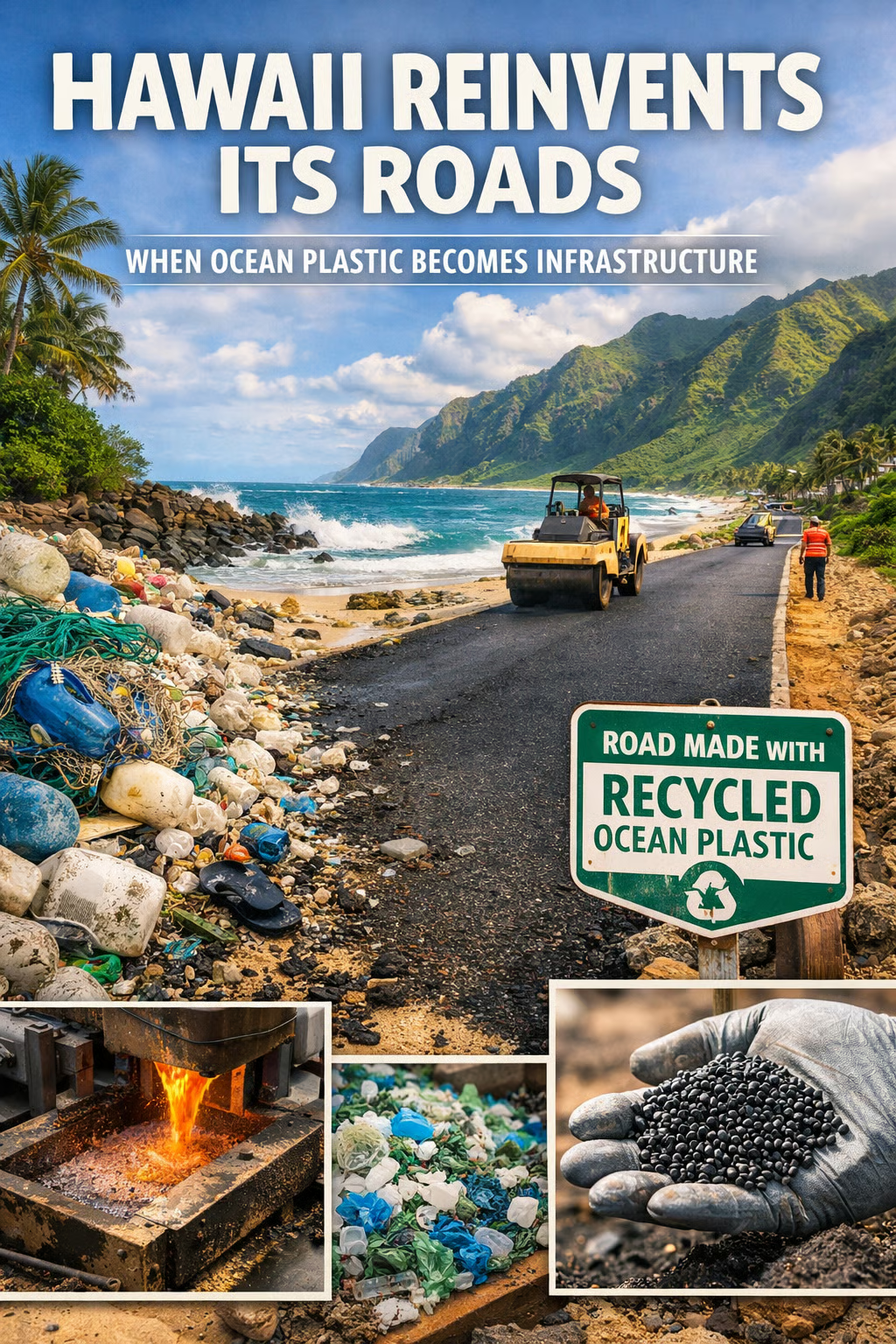 Image- R.E.News©
Au cœur du Pacifique, l’archipel d’Hawaï vit une équation impossible : des tonnes de déchets plastiques échouent sur ses côtes, tandis que leur traitement coûte cher, complexe et énergivore. Loin des grands centres de recyclage, chaque kilo de plastique devient un fardeau logistique… et environnemental.
Mais une idée simple, presque évidente, est en train de changer la donne : et si ces déchets devenaient une ressource stratégique pour construire ce dont l’île a constamment besoin — ses routes ?
Du déchet dérivant à la matière première locale
Sous l’impulsion des chercheurs de l’Hawaiʻi Pacific University, le plastique récupéré — filets de pêche abandonnés, emballages domestiques — est désormais transformé en additif pour enrobés routiers.
Le principe : intégrer du polyéthylène recyclé dans l’asphalte, en substitution partielle des polymères pétrosourcés utilisés dans les enrobés modernes. Une approche qui ne relève plus du laboratoire mais du terrain : des sections routières test ont été mises en service sur l’île d’Oahu, soumises aux conditions réelles de trafic, de chaleur et d’humidité tropicale.
Quand l’ingénierie routière devient circulaire
Depuis plusieurs années, Hawaï utilise majoritairement des enrobés modifiés aux polymères (PMA) pour améliorer la durabilité des chaussées. L’enjeu est donc clair : remplacer ces polymères industriels par du plastique recyclé sans compromettre la performance.
Les premiers résultats sont prometteurs :
comportement mécanique comparable aux solutions classiques
bonne résistance aux contraintes climatiques locales
intégration homogène du plastique dans le liant bitumineux
Mais surtout, cette approche transforme une contrainte majeure — la gestion des déchets — en levier industriel local.
Microplastiques : un débat recontextualisé
La question environnementale restait centrale : ces routes libèrent-elles davantage de microplastiques ?
Les analyses révèlent une réalité inattendue. Les particules issues de l’usure des pneus dominent largement celles provenant de l’asphalte, reléguant l’impact du plastique intégré à un niveau marginal. En clair, la route n’est pas le principal coupable — le véhicule l’est davantage.
Un constat qui redéfinit les priorités dans la lutte contre la pollution particulaire.
Une réponse locale à un défi global
Chaque année, plus de 400 millions de tonnes de plastique sont produites dans le monde. Parallèlement, le secteur des infrastructures cherche à réduire son empreinte carbone et à intégrer davantage de matériaux recyclés.
Dans ce contexte, Hawaï agit comme un laboratoire grandeur nature :
réduction des déchets envoyés en décharge
baisse des coûts liés à l’exportation des déchets
diminution de l’importation de matériaux vierges
création d’un modèle reproductible pour d’autres territoires insulaires
Vers une nouvelle génération d’infrastructures
Au-delà de la performance technique, cette innovation incarne une évolution plus profonde : celle d’une infrastructure capable d’absorber les déchets qu’elle génère indirectement.
Transformer des filets fantômes en routes durables n’efface pas la crise du plastique. Mais cela prouve qu’une économie circulaire appliquée aux infrastructures n’est plus une utopie — c’est une solution pragmatique, mesurable et déjà en circulation.
Dans un monde où chaque ressource compte, même les déchets les plus problématiques peuvent, littéralement, tracer la voie.
NJC.© Info
---------------------------------------------------------------------------------------------------------
15/04/26-English
Hawaii Reinvents Its Roads: When Ocean Plastic Becomes Infrastructure
Image- R.E.News©
In the heart of the Pacific, the Hawaiian archipelago faces an impossible equation: tons of plastic waste wash up on its shores, while its processing is expensive, complex, and energy-intensive. Far from major recycling centers, every kilogram of plastic becomes a logistical—and environmental—burden.
But a simple, almost obvious idea is changing the game: what if this waste became a strategic resource for building what the island constantly needs—its roads?
From Drifting Waste to Local Raw Material
Driven by researchers at Hawaii Pacific University, recovered plastic—abandoned fishing nets, household packaging—is now being transformed into an additive for road surfaces.
The principle: to integrate recycled polyethylene into asphalt, partially replacing the petroleum-based polymers used in modern road surfaces. An approach that is no longer confined to the laboratory but is now grounded in reality: test road sections have been put into service on the island of Oahu, subjected to real-world traffic conditions, heat, and tropical humidity.
When road engineering becomes circular
For several years, Hawaii has primarily used polymer-modified asphalt (PMA) to improve the durability of its pavements. The challenge is therefore clear: to replace these industrial polymers with recycled plastic without compromising performance.
The initial results are promising:
mechanical behavior comparable to conventional solutions
good resistance to local climatic stresses
homogeneous integration of the plastic into the bituminous binder
But above all, this approach transforms a major constraint—waste management—into a local industrial driver.
Microplastics: a debate recontextualized
The environmental question remained central: do these roads release more microplastics?
The analyses reveal an unexpected reality. Particles from tire wear far outweigh those from asphalt, relegating the impact of embedded plastic to a marginal level. In short, the road isn't the primary culprit—the vehicle is.
This finding redefines priorities in the fight against particulate pollution.
A local response to a global challenge
Every year, more than 400 million tons of plastic are produced worldwide. At the same time, the infrastructure sector is seeking to reduce its carbon footprint and incorporate more recycled materials.
In this context, Hawaii is acting as a full-scale laboratory:
reduced waste sent to landfills
lower costs associated with waste exports
decreased imports of virgin materials
creation of a replicable model for other island territories
Toward a new generation of infrastructure
Beyond technical performance, this innovation embodies a deeper evolution: that of infrastructure capable of absorbing the waste it indirectly generates.
Transforming ghost nets into sustainable roads doesn't erase the plastic crisis. But it proves that a circular economy applied to infrastructure is no longer a utopia—it's a pragmatic, measurable, and already implemented solution.
In a world where every resource counts, even the most problematic waste can, quite literally, lead the way.
NJC.© Info
------------------------------------------------------------------------------------------------------------------
15/04/26-NL
Hawaii vindt zijn wegen opnieuw uit: Wanneer oceaanplastic infrastructuur wordt
Image- R.E.News©
In het hart van de Stille Oceaan staat de Hawaiiaanse archipel voor een onmogelijke opgave: tonnen plastic afval spoelen aan op de kust, terwijl de verwerking ervan duur, complex en energie-intensief is. Ver van grote recyclingcentra vormt elke kilogram plastic een logistieke én milieubelasting.
Maar een simpel, bijna voor de hand liggend idee verandert de situatie: wat als dit afval een strategische grondstof zou worden voor de aanleg van wat het eiland constant nodig heeft: wegen?
Van drijvend afval tot lokale grondstof
Onder leiding van onderzoekers van Hawaii Pacific University wordt gerecycled plastic – achtergelaten visnetten, huishoudelijke verpakkingen – nu omgezet in een additief voor wegdekken.
Het principe: gerecycled polyethyleen integreren in asfalt, waarmee de op aardolie gebaseerde polymeren die in moderne wegdekken worden gebruikt, gedeeltelijk worden vervangen. Een aanpak die niet langer beperkt is tot het laboratorium, maar nu in de praktijk wordt toegepast: testweggedeelten zijn in gebruik genomen op het eiland Oahu en onderworpen aan realistische verkeersomstandigheden, hitte en tropische vochtigheid.
Wanneer wegenbouw circulair wordt
Hawaii gebruikt al jaren voornamelijk polymeer-gemodificeerd asfalt (PMA) om de duurzaamheid van het wegdek te verbeteren. De uitdaging is dan ook duidelijk: deze industriële polymeren vervangen door gerecycled plastic zonder dat dit ten koste gaat van de prestaties.
De eerste resultaten zijn veelbelovend:
mechanisch gedrag vergelijkbaar met conventionele oplossingen
goede weerstand tegen lokale klimaatinvloeden
homogene integratie van het plastic in het bitumineuze bindmiddel
Maar bovenal transformeert deze aanpak een belangrijke beperking – afvalbeheer – in een lokale industriële drijfveer.
Microplastics: een debat in een nieuw perspectief
De milieuvraag bleef centraal staan: stoten deze wegen meer microplastics uit?
De analyses onthullen een onverwachte realiteit. Deeltjes afkomstig van bandenslijtage zijn veel talrijker dan die van asfalt, waardoor de impact van ingebed plastic marginaal is. Kortom, de weg is niet de voornaamste boosdoener – het voertuig wel.
Deze bevinding herdefinieert de prioriteiten in de strijd tegen fijnstofvervuiling.
Een lokaal antwoord op een wereldwijde uitdaging
Elk jaar wordt er wereldwijd meer dan 400 miljoen ton plastic geproduceerd. Tegelijkertijd streeft de infrastructuursector ernaar zijn CO2-uitstoot te verminderen en meer gerecyclede materialen te gebruiken.
In deze context fungeert Hawaï als een volwaardig laboratorium:
minder afval dat naar stortplaatsen wordt afgevoerd
lagere kosten voor afvalexport
minder import van nieuwe materialen
het creëren van een reproduceerbaar model voor andere eilandgebieden
Op weg naar een nieuwe generatie infrastructuur
Naast de technische prestaties belichaamt deze innovatie een diepere evolutie: die van infrastructuur die in staat is het afval dat ze indirect genereert te absorberen.
Het transformeren van spooknetten in duurzame wegen lost de plasticcrisis niet op. Maar het bewijst wel dat een circulaire economie toegepast op infrastructuur geen utopie meer is – het is een pragmatische, meetbare en reeds geïmplementeerde oplossing.
In een wereld waar elke grondstof telt, kan zelfs het meest problematische afval letterlijk de weg wijzen.
NJC.© Info
--------------------------------------------------------------------------------------------------------------
Date de dernière mise à jour : 14/04/2026