










Warm Mix Asphalt Could Reshape Road Building Across Southeast Asia
 30/07/26-FR-English-NL-footer
L'enrobé tiède pourrait redessiner la construction routière en Asie du Sud-Est
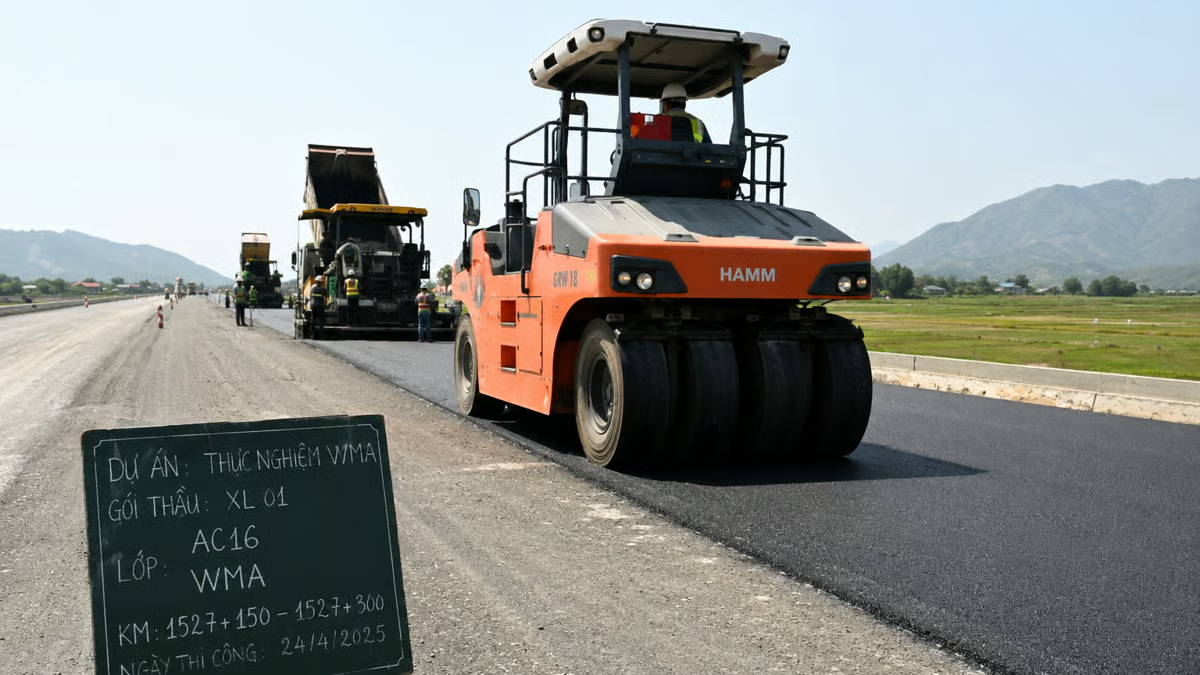 Image-R.E.News©
Un simple tronçon expérimental de 150 mètres au Vietnam pourrait bien annoncer une transformation majeure de l'industrie routière régionale. Mené par le Korea Institute of Civil Engineering and Building Technology (KICT) avec l'appui des autorités vietnamiennes et de Yoonsung Industrial Development, ce projet pilote compare un enrobé à chaud traditionnel à un Warm Mix Asphalt (WMA) produit à une température inférieure de 20 à 30 °C. Derrière cette expérimentation se cache un enjeu considérable : définir les futurs standards de construction de plusieurs milliers de kilomètres d'autoroutes.
Bien plus qu'un essai technique
Le véritable intérêt de ce démonstrateur ne réside pas dans les économies de CO₂ réalisées sur quelques centaines de mètres, mais dans son potentiel à influencer les futurs cahiers des charges d'un marché colossal.
Le Vietnam prévoit en effet de porter son réseau autoroutier à 5 000 km d'ici 2030, tout en poursuivant son objectif de neutralité carbone à l'horizon 2050. Chaque nouvelle infrastructure représente ainsi une opportunité d'intégrer des solutions capables de réduire l'empreinte environnementale sans compromettre les performances techniques.
Des performances qui dépassent les attentes
Les premiers essais en laboratoire sont particulièrement encourageants.
Comparé à un enrobé classique, le Warm Mix Asphalt affiche :
+10 % de résistance à la fissuration
+28 % de résistance aux déformations permanentes (orniérage)
une meilleure résistance à l'humidité, tout en respectant les exigences vietnamiennes.
Dans un pays soumis à un climat tropical et à un trafic intense de poids lourds, ces résultats changent profondément la perception du WMA : il ne s'agit plus seulement d'une technologie verte, mais d'une solution capable de réduire les coûts de maintenance sur l'ensemble du cycle de vie des infrastructures.
Les essais sous trafic réel, programmés sur douze mois, seront désormais décisifs pour confirmer ces performances.
La véritable bataille se joue dans la chimie
Au-delà de l'enrobé lui-même, la valeur économique se concentre aujourd'hui dans les additifs permettant de produire ces mélanges à basse température.
Grâce à une combinaison de cire diamine et de polymères développée par Yoonsung Industrial Development, la viscosité du liant diminue sans modifier les procédés de fabrication existants. Les centrales d'enrobage, les finisseurs et les méthodes de mise en œuvre restent pratiquement inchangés, ce qui facilite considérablement l'adoption de cette technologie.
Cette chimie devient ainsi un avantage concurrentiel majeur, alors que le marché mondial des additifs pour enrobés tièdes connaît une croissance soutenue.
Décarboner immédiatement la construction routière
Contrairement à l'électrification des flottes ou à la décarbonation du réseau électrique, l'enrobé tiède constitue une solution immédiatement opérationnelle.
En abaissant les températures de fabrication, les producteurs peuvent réduire :
jusqu'à 15 % de consommation énergétique ;
au moins 18 % d'émissions de CO₂, avec des gains pouvant atteindre des niveaux bien supérieurs selon les conditions de production.
Comme le chauffage des granulats représente la principale source de consommation énergétique d'une centrale d'enrobage, ces économies se traduisent directement par une baisse des coûts d'exploitation et de l'empreinte carbone.
Celui qui écrira les normes gagnera le marché
Le véritable enjeu dépasse largement la technologie.
Les autorités vietnamiennes cherchent désormais à élaborer des spécifications adaptées aux matériaux locaux, au climat tropical et aux conditions de circulation nationales. Les industriels capables d'apporter les données scientifiques qui serviront à construire ces futures normes disposeront d'un avantage durable sur les marchés publics des prochaines décennies.
C'est précisément la stratégie poursuivie par le partenariat entre le KICT, les autorités vietnamiennes et Yoonsung, qui associe recherche, démonstration grandeur nature et transfert de technologie afin d'accélérer l'adoption industrielle.
Un signal fort pour toute l'Asie du Sud-Est
Au-delà du Vietnam, cette expérimentation illustre l'évolution rapide de l'industrie routière asiatique. Les maîtres d'ouvrage recherchent désormais des solutions capables de conjuguer réduction des émissions, maîtrise des coûts et performances mécaniques.
Si les essais en conditions réelles confirment les résultats obtenus en laboratoire, le Warm Mix Asphalt pourrait rapidement devenir une référence régionale. L'enjeu ne sera plus seulement de construire des routes plus durables, mais de définir les futurs standards techniques qui orienteront les investissements, les chaînes d'approvisionnement et les innovations de toute l'industrie routière asiatique pour la prochaine décennie.
Le véritable héritage de ces 150 mètres d'autoroute ne sera donc pas ce tronçon expérimental, mais les milliers de kilomètres d'infrastructures qu'il pourrait influencer demain
NJC.© Info https://development.asia/insight/building-lower-carbon-roads-testing-warm-mix-asphalt-viet-nam
----------------------------------------------------------------------------------------------------------------
30/07/26-English
Warm Mix Asphalt Could Reshape Road Construction in Southeast Asia
Image-R.E.News©
A simple 150-meter experimental section in Vietnam could well herald a major transformation of the regional road industry. Led by the Korea Institute of Civil Engineering and Building Technology (KICT) with the support of Vietnamese authorities and Yoonsung Industrial Development, this pilot project compares traditional hot mix asphalt to Warm Mix Asphalt (WMA) produced at a temperature 20 to 30°C lower. Behind this experiment lies a considerable challenge: defining the future construction standards for thousands of kilometers of highways.
Much More Than a Technical Test
The true value of this demonstrator lies not in the CO₂ savings achieved over a few hundred meters, but in its potential to influence the future specifications of a colossal market.
Vietnam plans to expand its highway network to 5,000 km by 2030, while also pursuing its goal of carbon neutrality by 2050. Each new infrastructure project thus represents an opportunity to integrate solutions capable of reducing the environmental footprint without compromising technical performance.
Performance that exceeds expectations
Initial laboratory tests are particularly encouraging.
Compared to conventional asphalt, Warm Mix Asphalt exhibits:
+10% resistance to cracking
+28% resistance to permanent deformation (rutting)
improved resistance to moisture, while meeting Vietnamese requirements.
In a country with a tropical climate and heavy truck traffic, these results profoundly change the perception of WMA: it is no longer just a green technology, but a solution capable of reducing maintenance costs throughout the entire lifecycle of infrastructure.
The real-world traffic tests, scheduled over twelve months, will now be crucial in confirming these performance levels.
The real battle is being fought in the chemistry.
Beyond the asphalt mix itself, the economic value now lies in the additives that enable the production of these low-temperature mixtures.
Thanks to a combination of diamine wax and polymers developed by Yoonsung Industrial Development, the binder's viscosity is reduced without altering existing manufacturing processes. Asphalt plants, pavers, and application methods remain virtually unchanged, significantly facilitating the adoption of this technology.
This chemistry is thus becoming a major competitive advantage, as the global market for warm mix asphalt additives experiences sustained growth.
Immediately decarbonizing road construction
Unlike fleet electrification or grid decarbonization, warm mix asphalt offers an immediately operational solution.
By lowering manufacturing temperatures, producers can reduce:
energy consumption by up to 15%;
CO₂ emissions by at least 18%, with potentially much higher gains depending on production conditions.
Since heating aggregates is the primary energy consumption of an asphalt plant, these savings directly translate into lower operating costs and a reduced carbon footprint.
Whoever sets the standards will win the market.
The real issue goes far beyond technology.
Vietnamese authorities are now seeking to develop specifications adapted to local materials, the tropical climate, and national traffic conditions. Manufacturers capable of providing the scientific data needed to develop these future standards will have a lasting advantage in public procurement for decades to come.
This is precisely the strategy pursued by the partnership between KICT, the Vietnamese authorities, and Yoonsung, which combines research, full-scale demonstrations, and technology transfer to accelerate industrial adoption.
A strong signal for all of Southeast Asia
Beyond Vietnam, this experiment illustrates the rapid evolution of the Asian road industry. Project owners are now seeking solutions that combine emission reduction, cost control, and mechanical performance.
If real-world testing confirms the results obtained in the laboratory, Warm Mix Asphalt could quickly become a regional benchmark. The challenge will no longer be simply to build more sustainable roads, but to define the future technical standards that will guide investments, supply chains, and innovations across the entire Asian road industry for the next decade.
The true legacy of these 150 meters of highway will therefore not be this experimental section, but the thousands of kilometers of infrastructure it could influence in the future.
NJC.© Info https://development.asia/insight/building-lower-carbon-roads-testing-warm-mix-asphalt-viet-nam
--------------------------------------------------------------------------------------------------------------
30/07/26-NL
Warm mengasfalt zou de wegenbouw in Zuidoost-Azië kunnen hervormen
Image-R.E.News©
Een eenvoudig experimenteel traject van 150 meter in Vietnam zou wel eens een grote transformatie van de regionale wegenbouwsector kunnen inluiden. Dit pilotproject, geleid door het Korea Institute of Civil Engineering and Building Technology (KICT) met steun van de Vietnamese overheid en Yoonsung Industrial Development, vergelijkt traditioneel heet mengasfalt met warm mengasfalt (WMA), dat wordt geproduceerd bij een temperatuur die 20 tot 30 °C lager ligt. Achter dit experiment schuilt een aanzienlijke uitdaging: het bepalen van de toekomstige bouwstandaarden voor duizenden kilometers snelwegen.
Veel meer dan een technische test
De werkelijke waarde van deze demonstratie ligt niet in de CO₂-besparing die over een paar honderd meter wordt behaald, maar in het potentieel om de toekomstige specificaties van een gigantische markt te beïnvloeden.
Vietnam is van plan zijn snelwegennet tegen 2030 uit te breiden tot 5.000 km en streeft tegelijkertijd naar CO₂-neutraliteit in 2050. Elk nieuw infrastructuurproject biedt daarom een kans om oplossingen te integreren die de ecologische voetafdruk verkleinen zonder afbreuk te doen aan de technische prestaties.
Prestaties die de verwachtingen overtreffen
De eerste laboratoriumtests zijn bijzonder veelbelovend.
Vergeleken met conventioneel asfalt vertoont Warm Mix Asphalt (WMA):
+10% weerstand tegen scheurvorming
+28% weerstand tegen permanente vervorming (spoorvorming)
verbeterde vochtbestendigheid, terwijl het voldoet aan de Vietnamese eisen.
In een land met een tropisch klimaat en veel vrachtverkeer veranderen deze resultaten de perceptie van WMA ingrijpend: het is niet langer alleen een groene technologie, maar een oplossing die de onderhoudskosten gedurende de gehele levenscyclus van de infrastructuur kan verlagen.
De praktijktests met verkeer, die over een periode van twaalf maanden gepland staan, zullen nu cruciaal zijn om deze prestatieniveaus te bevestigen.
De echte strijd wordt gestreden in de chemie.
Naast het asfaltmengsel zelf ligt de economische waarde nu in de additieven die de productie van deze mengsels bij lage temperaturen mogelijk maken.
Dankzij een combinatie van diaminewas en polymeren, ontwikkeld door Yoonsung Industrial Development, wordt de viscositeit van het bindmiddel verlaagd zonder de bestaande productieprocessen te wijzigen. Asfaltcentrales, asfalteermachines en applicatiemethoden blijven vrijwel onveranderd, wat de toepassing van deze technologie aanzienlijk vergemakkelijkt.
Deze chemie wordt zo een belangrijk concurrentievoordeel, aangezien de wereldwijde markt voor warm mengasfaltadditieven een aanhoudende groei doormaakt.
Directe decarbonisatie van de wegenbouw
In tegenstelling tot de elektrificatie van het wagenpark of de decarbonisatie van het elektriciteitsnet, biedt warm mengasfalt een direct operationele oplossing.
Door de productietemperaturen te verlagen, kunnen producenten:
het energieverbruik met maximaal 15% verminderen;
de CO₂-uitstoot met ten minste 18% verminderen, met mogelijk veel hogere winsten afhankelijk van de productieomstandigheden.
Aangezien het verwarmen van aggregaten het grootste energieverbruik van een asfaltcentrale is, vertalen deze besparingen zich direct in lagere operationele kosten en een kleinere CO₂-voetafdruk.
Wie de normen bepaalt, wint de markt.
De werkelijke kwestie gaat veel verder dan technologie.
De Vietnamese autoriteiten streven er nu naar specificaties te ontwikkelen die zijn aangepast aan lokale materialen, het tropische klimaat en de nationale verkeersomstandigheden. Fabrikanten die de wetenschappelijke gegevens kunnen leveren die nodig zijn voor de ontwikkeling van deze toekomstige normen, zullen de komende decennia een blijvend voordeel hebben bij overheidsaanbestedingen.
Dit is precies de strategie die wordt nagestreefd door het partnerschap tussen KICT, de Vietnamese autoriteiten en Yoonsung. Dit partnerschap combineert onderzoek, grootschalige demonstraties en technologieoverdracht om de industriële toepassing te versnellen.
Een sterk signaal voor heel Zuidoost-Azië
Buiten Vietnam illustreert dit experiment de snelle evolutie van de Aziatische wegenbouwsector. Projecteigenaren zoeken nu naar oplossingen die emissiereductie, kostenbeheersing en mechanische prestaties combineren.
Als praktijktests de in het laboratorium verkregen resultaten bevestigen, zou Warm Mix Asphalt snel een regionale standaard kunnen worden. De uitdaging zal niet langer alleen bestaan uit het aanleggen van duurzamere wegen, maar uit het definiëren van de toekomstige technische normen die de investeringen, toeleveringsketens en innovaties in de gehele Aziatische wegenbouwsector de komende tien jaar zullen sturen.
De ware erfenis van deze 150 meter snelweg zal daarom niet dit experimentele gedeelte zijn, maar de duizenden kilometers infrastructuur die het in de toekomst zou kunnen beïnvloeden.
NJC.© Info https://development.asia/insight/building-lower-carbon-roads-testing-warm-mix-asphalt-viet-nam
--------------------------------------------------------------------------------------------------------------
Date de dernière mise à jour : 29/07/2026