



Why Repeatable Construction Systems are Gaining Popularity
 30/07/26-FR-English-NL-footer
Les systèmes constructifs répétitifs s'imposent comme le nouveau standard du BTP britannique
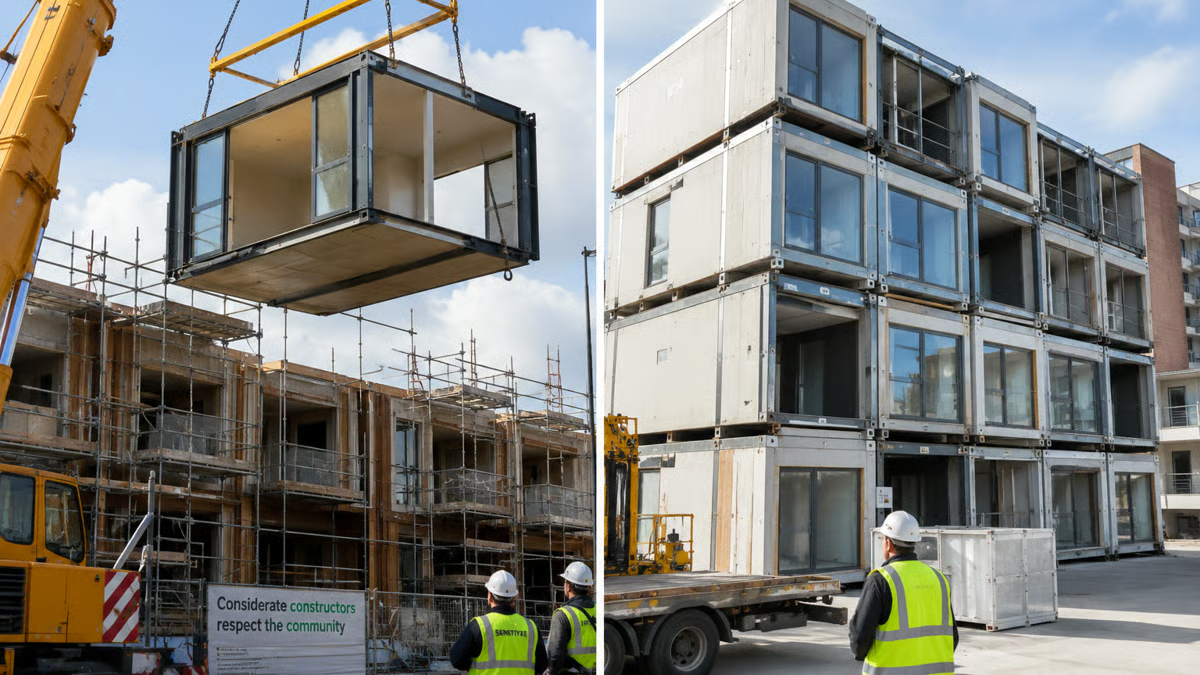 Image-R.E.News©
Face à la pénurie de logements, aux tensions sur la main-d'œuvre et à la pression croissante sur les coûts, le secteur britannique de la construction accélère sa transition vers les systèmes constructifs répétitifs. Basés sur des composants préfabriqués ou des modules standardisés produits en usine puis assemblés sur chantier, ces procédés ne sont plus une simple alternative : ils deviennent un véritable levier industriel.
Construire plus vite, sans sacrifier la qualité
Avec un objectif gouvernemental de 1,5 million de nouveaux logements, le Royaume-Uni doit profondément repenser ses méthodes de construction. La répétition de modèles éprouvés permet de réduire les études, d'accélérer les autorisations et de raccourcir considérablement les délais. Selon les références du secteur, la construction modulaire peut diminuer le temps de réalisation de près de 50 %.
La préfabrication transforme également l'organisation des chantiers. Produits en parallèle des travaux de terrassement, les éléments arrivent prêts à être installés, limitant les retards liés aux conditions météorologiques, aux pénuries de main-d'œuvre ou aux perturbations logistiques. Dans certains projets, jusqu'à 80 % des opérations sont transférées en environnement industriel.
Prévisibilité : le nouvel avantage concurrentiel
Au-delà du gain de temps, la standardisation apporte une meilleure maîtrise financière. La fabrication en série réduit les déchets, optimise les achats de matériaux et améliore la précision des coûts. Pour les maîtres d'ouvrage, les investisseurs et les collectivités, cette prévisibilité devient un atout stratégique dans un contexte économique marqué par l'inflation des matériaux et l'incertitude budgétaire.
Les spécialistes de la préfabrication, à l'image de JP Concrete, démontrent déjà l'efficacité de ce modèle sur des projets d'infrastructures où la répétition des composants garantit des délais plus courts et une qualité constante.
Une réponse durable aux défis du secteur
Les systèmes répétitifs répondent également à deux enjeux majeurs : le manque de compétences et la transition environnementale. En transférant une partie de la production vers l'usine, ils réduisent la dépendance aux métiers en tension tout en offrant des conditions de travail plus sûres et plus attractives.
La fabrication industrielle améliore en parallèle la précision des assemblages, limite les déchets et facilite l'intégration de solutions énergétiques performantes. Les bâtiments modulaires, plus facilement adaptables et démontables, s'inscrivent pleinement dans les objectifs britanniques de neutralité carbone.
Vers une nouvelle révolution industrielle du bâtiment
Portée par la digitalisation, l'automatisation et la préfabrication, la construction répétitive s'impose progressivement comme un nouveau modèle économique. Pour un secteur appelé à construire davantage avec moins de ressources, elle offre une combinaison rare de rapidité, maîtrise des coûts, qualité et durabilité.
Plus qu'une évolution technique, cette approche pourrait redéfinir durablement la manière dont les infrastructures et les logements seront conçus au Royaume-Uni… avant de devenir une référence pour l'ensemble du marché européen.
NJC.© Info https://www.theguardian.com/europe https://www.jpconcrete.co.uk/
-------------------------------------------------------------------------------------------------------------
30/07/26-English
Repetitive Construction Systems Are Emerging as the New Standard in the British Construction Industry
Image-R.E.News©
Faced with a housing shortage, labor shortages, and increasing cost pressures, the British construction sector is accelerating its transition to repetitive construction systems. Based on prefabricated components or standardized modules produced in factories and then assembled on-site, these methods are no longer simply an alternative: they are becoming a true industrial driver.
Building Faster, Without Sacrificing Quality
With a government target of 1.5 million new homes, the United Kingdom must fundamentally rethink its construction methods. Repeating proven models reduces planning, accelerates permitting, and significantly shortens construction times. According to industry benchmarks, modular construction can reduce completion time by nearly 50%.
Prefabrication is also transforming the organization of construction sites. Produced alongside the excavation work, the components arrive ready for installation, minimizing delays caused by weather conditions, labor shortages, or logistical disruptions. In some projects, up to 80% of operations are transferred to an industrial setting.
Predictability: The New Competitive Advantage
Beyond saving time, standardization provides better financial control. Mass production reduces waste, optimizes material purchases, and improves cost accuracy. For project owners, investors, and local authorities, this predictability is becoming a strategic asset in an economic context marked by rising material prices and budgetary uncertainty.
Prefabrication specialists, such as JP Concrete, are already demonstrating the effectiveness of this model on infrastructure projects where the repetition of components guarantees shorter lead times and consistent quality.
A Sustainable Response to the Sector's Challenges
Repetitive systems also address two major challenges: skills shortages and the environmental transition. By transferring some production to the factory, they reduce reliance on in-demand jobs while offering safer and more attractive working conditions.
Industrial manufacturing simultaneously improves assembly precision, reduces waste, and facilitates the integration of high-performance energy solutions. Modular buildings, which are more easily adaptable and demountable, are fully aligned with the UK's carbon neutrality goals.
Towards a New Industrial Revolution in Construction
Driven by digitalization, automation, and prefabrication, repetitive construction is gradually establishing itself as a new economic model. For a sector called upon to build more with fewer resources, it offers a rare combination of speed, cost control, quality, and sustainability.
More than just a technological evolution, this approach could permanently redefine how infrastructure and housing are designed in the UK… before becoming a benchmark for the entire European market.
NJC.© Info https://www.theguardian.com/europe https://www.jpconcrete.co.uk/
--------------------------------------------------------------------------------------------------------------------
30/07/26-NL
Repetitieve bouwmethoden ontwikkelen zich tot de nieuwe standaard in de Britse bouwsector
Image-R.E.News©
Geconfronteerd met een woningtekort, een tekort aan arbeidskrachten en toenemende kosten, versnelt de Britse bouwsector de overgang naar repetitieve bouwmethoden. Deze methoden, gebaseerd op geprefabriceerde componenten of gestandaardiseerde modules die in fabrieken worden geproduceerd en vervolgens op de bouwplaats worden gemonteerd, zijn niet langer slechts een alternatief: ze worden een echte drijvende kracht in de industrie.
Sneller bouwen zonder in te leveren op kwaliteit
Met een overheidsdoelstelling van 1,5 miljoen nieuwe woningen moet het Verenigd Koninkrijk zijn bouwmethoden fundamenteel herzien. Het herhalen van beproefde modellen vermindert de planning, versnelt de vergunningsprocedures en verkort de bouwtijd aanzienlijk. Volgens branchebenchmarks kan modulaire bouw de bouwtijd met bijna 50% verkorten.
Prefabricage transformeert ook de organisatie van bouwplaatsen. De componenten worden tegelijk met de grondwerken geproduceerd en komen kant-en-klaar aan, waardoor vertragingen door weersomstandigheden, arbeidstekorten of logistieke problemen tot een minimum worden beperkt. Bij sommige projecten wordt tot 80% van de werkzaamheden naar een industriële omgeving verplaatst.
Voorspelbaarheid: Het nieuwe concurrentievoordeel
Naast tijdsbesparing biedt standaardisatie betere financiële controle. Massaproductie vermindert afval, optimaliseert materiaalinkoop en verbetert de kostennauwkeurigheid. Voor projecteigenaren, investeerders en lokale overheden wordt deze voorspelbaarheid een strategische troef in een economische context die wordt gekenmerkt door stijgende materiaalprijzen en budgettaire onzekerheid.
Prefabricagespecialisten, zoals JP Concrete, tonen de effectiviteit van dit model al aan bij infrastructuurprojecten, waar de herhaling van componenten kortere doorlooptijden en een constante kwaliteit garandeert.
Een duurzaam antwoord op de uitdagingen in de sector
Repetitieve systemen pakken ook twee belangrijke uitdagingen aan: tekorten aan geschoolde arbeidskrachten en de ecologische transitie. Door een deel van de productie naar de fabriek te verplaatsen, verminderen ze de afhankelijkheid van gewilde banen en bieden ze veiligere en aantrekkelijkere arbeidsomstandigheden.
Industriële productie verbetert tegelijkertijd de assemblageprecisie, vermindert afval en vergemakkelijkt de integratie van hoogwaardige energieoplossingen. Modulaire gebouwen, die gemakkelijker aanpasbaar en demonteerbaar zijn, sluiten volledig aan bij de Britse doelstellingen voor CO2-neutraliteit.
Op weg naar een nieuwe industriële revolutie in de bouw
Gedreven door digitalisering, automatisering en prefabricage, vestigt repetitieve bouw zich geleidelijk aan als een nieuw economisch model. Voor een sector die wordt opgeroepen om meer te bouwen met minder middelen, biedt het een zeldzame combinatie van snelheid, kostenbeheersing, kwaliteit en duurzaamheid.
Meer dan alleen een technologische evolutie, zou deze aanpak de manier waarop infrastructuur en woningen in het Verenigd Koninkrijk worden ontworpen, permanent kunnen herdefiniëren… voordat het een maatstaf wordt voor de gehele Europese markt.
NJC.© Info https://www.theguardian.com/europe https://www.jpconcrete.co.uk/
------------------------------------------------------------------------------------------------------------
Date de dernière mise à jour : 29/07/2026